



The Principles of Summum
and The Lord of the Rings
One Principle that binds them All,
One Principle that guides them,
Seven Principles imbued in All,
in Light and Dark we find them...
Some who read this verse will immediately think of The Lord of the Rings. It's natural, for the rhythm echoes J.R.R. Tolkien's poetic style. It is a fitting introduction to a deeper connection: Tolkien's epic story and legendarium exemplify the Seven Principles of Summum.
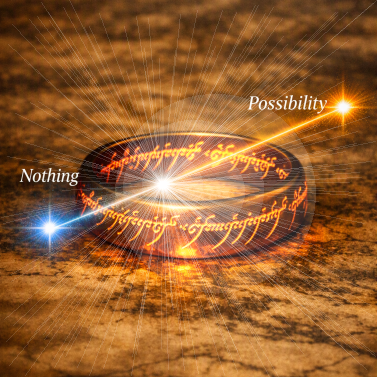
- Psychokinesis (The universe is a mental creation): In Tolkien's mythology, the entire universe (Eä) proceeded from the mental vision of Eru Ilúvatar who had the ability to bring forth existence from nothingness. This reality was expressed into being by the Music of the Ainur. In the LOTR narrative, the power of a being's mind and will dictates reality — just as Sauron's will-power holds Barad-dûr together, Galadriel's mind protects Lothlórien.
- Correspondence (As above, so below): The physical conflicts of Middle-earth mirror the greater spiritual battles of the higher realms. The internal, moral struggles of characters like Frodo or Boromir correspond to the macro-political fate of kingdoms.
- Vibration (Everything moves & vibrates): Tolkien's world is built on sound frequencies. The world was created through the musical resonations of the Ainur. Holy words, Elven hymns, and Sauron's Black Speech carry distinct spiritual frequencies that physically alter environments and soothe or corrupt minds.
- Opposition (Everything is dual): Light and darkness, freedom and domination, courage and fear — they express opposing conditions that shape the choices and struggles of Middle-earth. Good and evil often share a singular origin. Once the mightiest of the holy Ainur, Melkor turned into the dark lord, Morgoth. Similarly, Gollum and Frodo represent two poles of the same nature, showing how easily one can slide into the other.
- Rhythm (The pendulum swing): The Ages of Middle-earth operate in cycles of rise and fall. The power of the Elves fades as Men ascend. Dark lords rise to power, only to fall into ruin. No state of dominion or peace is permanent.
- Cause and Effect (Everything happens according to law): As Gandalf notes, Frodo was meant to find the Ring, and Bilbo was meant to leave it. Every choice, no matter how small, has a cascading effect. Bilbo sparing Gollum's life ultimately saves the world. True chance does not exist.
- Gender (Masculine and feminine): Creation requires masculine projecting and feminine receiving forces. This is seen in the Valar pairing of Aulë and Yavanna: Aulë projected directing energy to forge the stone foundations of the world, which Yavanna received and nurtured to manifest living trees and plants. Similarly, Sauron projects his dominant will where it is received by the pits of Mordor to generate armies of Orcs — and received throughout Middle-earth, creating feelings of dread and despair across the lands.
The real world gives us many examples of the Summum principles at work, and Tolkien's stories were shaped by real-world influences. The Lord of the Rings is not just a struggle between good and evil. Through the choices of its characters and the unfolding of events, it offers a way to consider deeper principles that govern existence. The Seven Principles of Summum invite us to look beyond the surface of the story and recognize these patterns in the world around us.
* The content of this page was developed with the assistance of AI and reviewed and refined by a human.

"The voice of wisdom is silent, except to the OPEN MIND."
